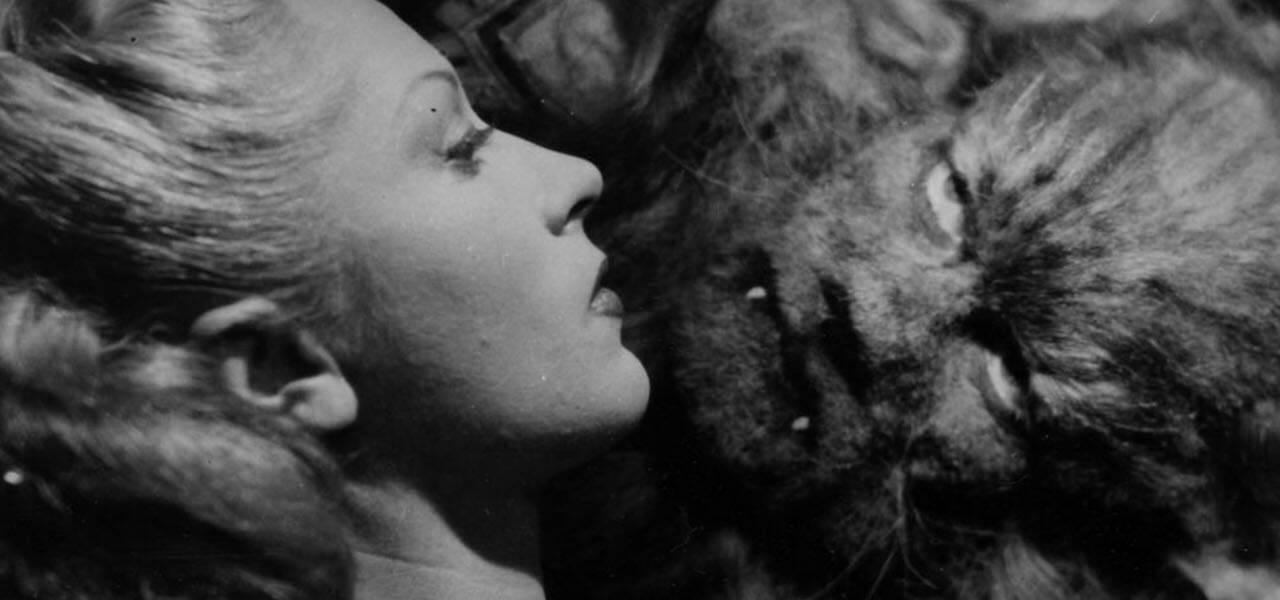
This new realm unsettled me, disturbed me, captivated me. Without realising it, I had made a music of my own… but the swell of the orchestra was going the opposite way. Little by little, Auric’s score prevailed over my absurd unease. This music embraces, permeates, exalts and completes the film.
Jean Cocteau
There is no doubt that Beauty and the Beast is one of the great masterpieces of French cinema of the immediate post-war period. Directed by Jean Cocteau, himself assisted by René Clément, and filmed in August 1945, the work brings together the foremost talents of its time. In adapting the tale by Jeanne-Marie Leprince de Beaumont, Jean Cocteau conceived the screenplay and the staging simultaneously, seeking to inscribe them within a highly precise visual universe.
At once a homage to the great masters of 17th-century Dutch painting, such as Pieter de Hooch and Johannes Vermeer, who were then discovering the use of the camera obscura, Beauty and the Beast also drew upon the art of 19th-century engraving, notably that of Gustave Doré. It was the directional light of these engravings that guided the eye of Henri Alekan, director of photography, as he cast his spotlights upon the sets designed by Christian Bérard.
Brought to life by Josette Day (Belle), Marcel André (the Father), Michel Auclair (Ludovic), and Jean Marais (the Beast, the Prince, and Avenant), the costumes by Georges Escoffier were enhanced by the extraordinary make-up of Hagop Arakélian, which required Jean Marais to spend three to four hours each day transforming his face alone. A work at once popular and exacting, Beauty and the Beast is a fantastical, grave, and moving film, one that probes love as much as death.
Georges Auric’s score plays no small part of this achievement: a committed composer of the Front populaire, affiliated with the Groupe des Six, and active in the French Resistance during the Vichy regime and the Occupation, Auric had been a close collaborator of Jean Cocteau for nearly thirty years. In counterpoint to the voice of the narrator, embodied by Cocteau himself, the music becomes a fully fledged narrative element, serving both the poetic and the fantastic.
To mark 80 years since the film’s release, the Orchestre Philharmonique de Radio France will take part in the world premiere screening of the film in a ciné-concert format.